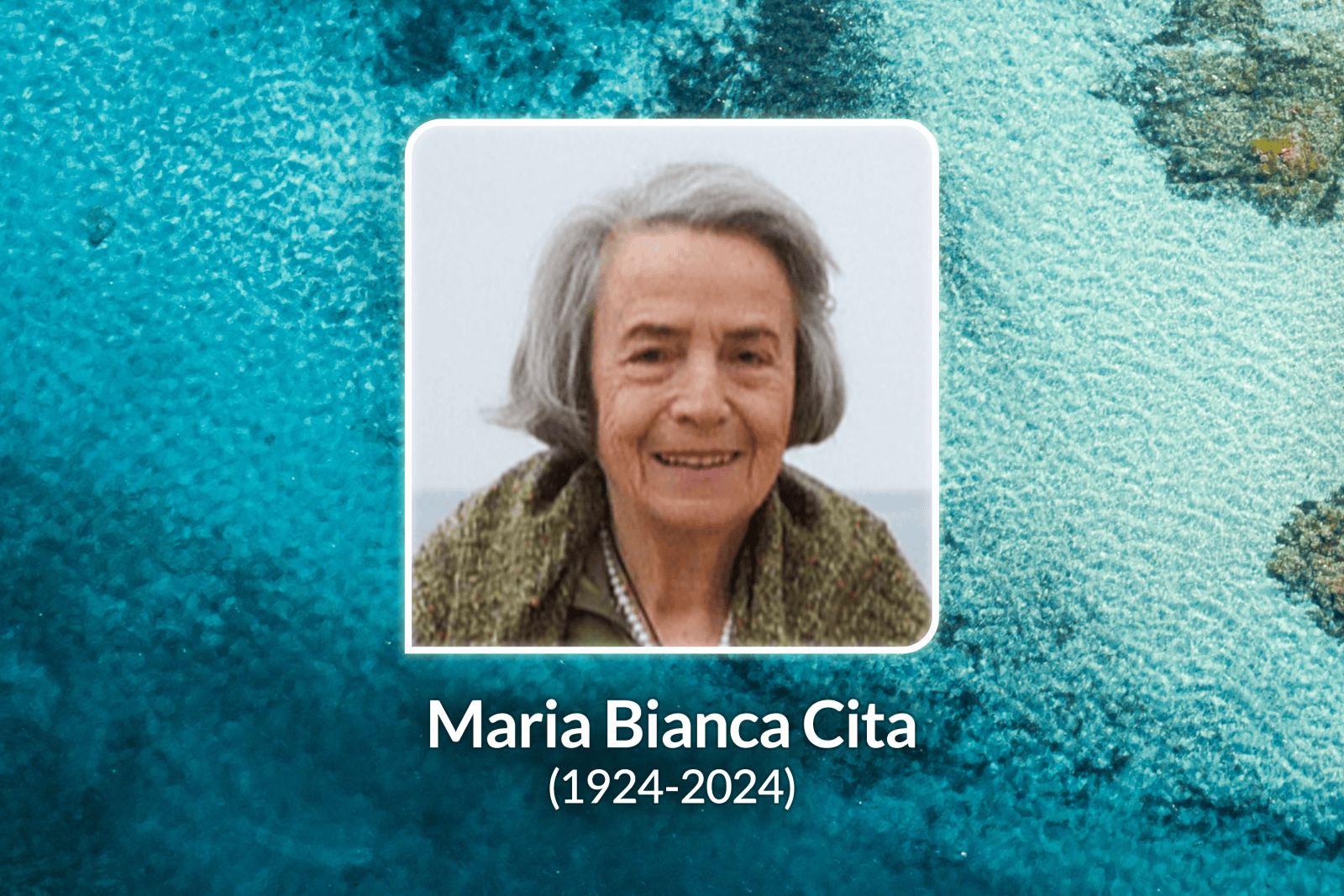
Maria Bianca Cita Sironi was a well-known Italian geoscientist who was a pioneer in the fields of marine geology and micropalaeontology. Her outstanding academic legacy and accomplishments are still inspiring women in science today.
(Photo courtesy of Prof. Elisabetta Erba)
Women in Early 20th Century Italian Earth Sciences
Until 1942, all Earth Science courses in Italian universities were part of the Natural Sciences degree. That year, Geological Sciences became a distinct degree at the Universities of Milan, Rome and Padua. At this time, few women were present in scientific departments, especially in Earth Sciences. Even fewer held senior academic roles. Nevertheless, women played an important role in advancing the study of palaeontology in Italy.
Among the pioneers we should mention
- Eugenia Montanaro Gallitelli (1906-1997), who founded the “Bollettino della Società Paleontologica Italiana” in 1960
- Ida Comaschi Caria (1911-1987), palaeontologist, first Sardinian woman to become professor at the University of Cagliari.
- Oplinia Hieke Merlin (1915-2006) with a degree in Natural Science and one in Chemistry, she was a petrologist and vulcanologist.
- Carla Rossi Ronchetti (1916-2000), a long-time editor and eventually director for over 30 years of the “Rivista Italiana di Paleontologia e Stratigrafia”, a journal founded in 1895.
These scientists carried out remarkable research, despite the social restrictions of their time. In the early 20th century, it was extremely difficult for a woman to take part in productive fieldwork for two main reasons. Firstly, it was expected that they should be chaperoned by a male relative, like a husband or brother. Secondly, they had to keep wearing formal dresses with long skirts and fancy hats (not practical for hiking or hammering a rock!).
Maria Bianca Cita – A Biography
Maria Bianca’s brilliant academic career
Born in Milan in 1924, Maria Bianca Cita was the first woman to enrol in the new geology degree (Corso di Laurea in Scienze Geologiche) when it opened at the University of Milan in 1942. She earned her master in 1946, obtaining top honours. By 1955 she was already an active field geologist and micropalaeontologist. Her early research focused on the Cretaceous/Paleogene boundary and the important role of planktonic foraminifera in global stratigraphic correlation.
Maria Bianca spent her entire brilliant academic career at the University of Milan, eventually becoming a full professor in 1973 and Head of the Earth Science Department in 1982. In 1989, she was the first woman elected president of the Italian Geological Society.
She published over 300 scientific papers in some of the highest-impact geoscience publications. Her broad sphere of research interests covered palaeontology, stratigraphy, palaeoceanography, palaeoclimatology and marine geology. Her studies on the desiccation of the Mediterranean, deep-sea anoxic brine lakes, mud volcanos and homogenites are considered keystone publications in her field.
Her contributions were recognised with prestigious honours, including:
- Feltrinelli Prize, Accademia dei Lincei (1986)
- Francis P. Shepard Medal for Marine Geology (1996)
- Honorary Fellow, Geological Society of America
- Professor Emeritus, University of Milan
Maria Bianca’s scientific research voyages
Maria Bianca played a leading role in international scientific ocean drilling. In 1968, she joined DSDP Leg 2, becoming the first non-American scientist and one of the first two women to sail on the Glomar Challenger.
She later sailed on:
- DSDP Leg 13 (1970), a key voyage in developing the theory of the Messinian salinity crisis
- Jean Charcot (1972)
- DSDP Leg 42A (1975)
- DSV Alvin deep submersible (1977, 1978)
- Eastward (1978, co-chief scientist)
- DSDP Leg 47A (1979)
- Salernum (1979, chief scientist)
- Bannock (chief scientist on seven cruises between 1980 and 1989)
Her participation in these missions reflected her expertise in microfossils and marine geology, as well as her standing in the international scientific community.

Key papers
- Cita, M. B. (1956). Guida allo studio della micropaleontologia. Milan, La Goliardica – First textbook in Italian about micropalaeontology
- Cita, M. B. (1965). Jurassic, Cretaceous and Tertiary microfacies from the Southern Alps (Northern Italy). E. J. Brill, Leiden, The Netherlands. 8: 1-99
- Hsü, K. J., Ryan, W., Cita, M. B. (1973). Late Miocene Desiccation of the Mediterranean. Nature, 242, 240–244
- Hsü, K. J., Montadert, L., Bernoulli, D., Cita, M. B., Erickson, A., Garrison, R. E., Kidd, R. B., Mélières, F., Müller, C., Wright, R. (1977). History of the Mediterranean salinity crisis. Nature, 267, 399–403
- Kidd, R.B., Cita, M. B., Ryan, W.B.F. (1978). Stratigraphy of eastern Mediterranean sapropel sequences recovered during DSDP Leg 42A and their paleoenvironmental significance, in Hsü, K.J., Montadert, L., et al., Initial Reports of the Deep Sea Drilling Project, 42, 421-443