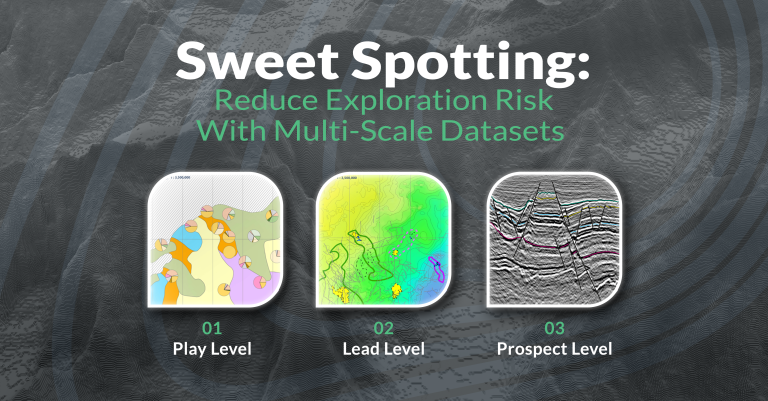
Sweet Spotting: Reduce Exploration Risk With Multi-Scale Datasets
Sweet spotting is a method to locate where the probability of hydrocarbon presence and commercial success is highest within a basin or play.


Sweet spotting is a method to locate where the probability of hydrocarbon presence and commercial success is highest within a basin or play.

We dig into what data science means for us and how it can help us deliver better, faster, and more accurate results.

We highlight the digital tools and technologies that will optimise our daily workflows and enhance collaboration between teams and clients.

In this post, we'll share the key milestones and lessons learnt from our experiences over the past few years as we've laid the groundwork for a more digitally-driven future.

Digging deeper into why digitalisation is vital for PetroStrat, and how it will support future success for us and our clients.

In this series, we'll dive into the "what," "why," and "how" of digital transformation — from the latest tools to leveraging data science.

The complex interplay of controls upon reservoir quality became evident as our analytical datasets were integrated and visualised

Our detailed assessments of the depositional and diagenetic controls upon reservoir quality, are aided by acquiring and interpreting SEM (Scanning Electron Microscopy) imagery.

Core descriptions at the NPD Geobank, are being undertaken across the Tilje, Tofte and Ile formations through ~2.7km of core in 30 wells.

In the third part of our Sub-Garn Sand Complex Blog we present our Petrographic Data Capture, ensuring consistent data underpins this study.

Our Sub-Garn project team arrived at the NPD Geobank in Stavanger, armed with the permission to collect core samples over this 2-week visit.

Part 1 of our Sub-Garn Sand Complex Blog; covering sampling selection, alongside stratigraphic database and biostratigraphic framework.