PetroStrat will be exhibiting a cutting-edge poster at the 32nd IMOG (International Meeting on Organic Geochemistry). The event will be held in Porto, Portugal, from September 7 to 11 2025.
This biennial conference gathers petroleum system analysts and geochemists from academia and industry. The focus on this event is collaboration and to provide space to share the latest research and developments in organic chemistry, petroleum exploration, environmental geochemistry, and carbon cycling. IMOG is a key event for those working in the intersection of hydrocarbon exploration and geochemistry, as it offers a platform for the exchange of analytical advances, workflows, and applied research. We look forward to networking with academics, operators and anyone involved in organic geochemistry and the energy sector.
PetroStrat Poster: Light Hydrocarbon Geochemistry in the Levantine Basin
Poster title: Geochemistry of Light Hydrocarbon Compounds (LHC) in Crude Oils from the Levantine Basin, Offshore Israel
Authors: Carolina Olivares (PetroStrat), Davide di Biase (Energean), Douglas Moura (PetroStrat), Olaia Zarqueta (PetroStrat), Andrew Parry (PetroStrat)
Session: Poster Sessions (lunchtime, daily)
Date: 7–11 September 2025
The poster summarises the findings from comparative analysis of light hydrocarbon compound (LHC) data from twelve crude oil samples from five fields in the Levantine Basin, offshore Israel. The study evaluates how evaporation impacts LHC ratios and how this affects the interpretation of geochemical transformation and correlation processes.
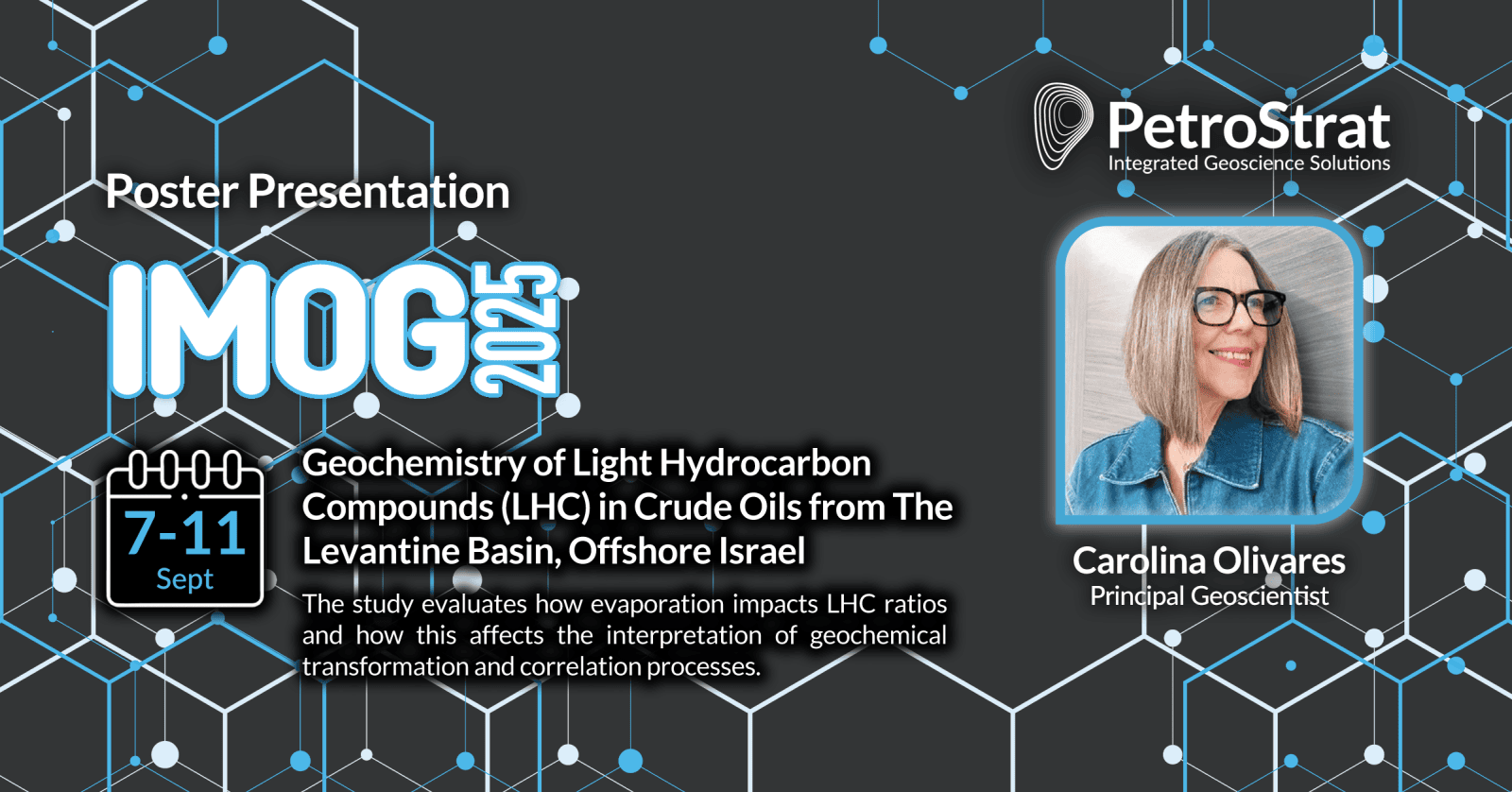
Executive summary by Carolina Olivares and our Geochemistry team
The geochemistry of light hydrocarbon compounds (LHC) has been assessed in twelve crude oils reservoired in Oligo-Miocene to Miocene sands from five fields (A, B, C, D and E) located in the Levantine Basin, Offshore Israel. The objective is to evaluate the impact of evaporation in interpreting correlation (oil-oil) and transformation (evaporative fractionation, water washing, biodegradation and maturity) processes of the oils.
The analytical workflow included an initial qualitative chromatographic separation on the crude oil samples to recognise the main compound classes, followed by isolation and quantification of the light hydrocarbons compounds (LHC) to obtain the peak and ratios required to conduct the interpretation. These results (termed ‘time2’) were compared against LHC ratios obtained when the wells were initially drilled (hereby and thereafter referred to as ‘time1’). Similarities and important differences were observed during the comparison, indicating that evaporation has impacted the most recently analysed samples, therefore affecting the interpretation of key transformation processes such as fractionation, biodegradation, maturity and water washing. Identifying these alterations early in the oil geochemistry (light-to-heavy molecular weight characterisation) workflow will reduce uncertainties when performing oil-oil correlations, grouping oils and the whole understanding of the petroleum systems.
Short bios of the PetroStrat authors
Carolina Olivares (Presenting)

Carolina is a geochemist and petroleum systems analyst with more than 30 years of experience in the Oil and Gas industry, working in NOC , IOC and consultancy companies, not only as a team member but also leading multidisciplinary teams . Her fields of expertise includes geochemical characterisation of source rocks and fluids (oil, gas, water), fluids-source rock correlation , geological integration, basin modelling methods at exploration, fields appraisal and development scale, exploration workflows and energy transition (Natural Hydrogen and Helium exploration)
Douglas Rodrigues

Douglas has almost 10 years of experience in the oil and gas industry, working for both, operating and consultancy companies. His main technical experience relies on organic geochemistry for fluids and rocks, PSA, basin modelling seismic interpretation and petrophysical evaluation.
Olaia Zarketa

Olaia Zarketa has worked for a geological consultancy for 20 years as a lab technician, including the past two years as a specialist technician. She has developed a broad experience across multiple laboratory disciplines, spanning from biostratigraphy, SEM and QEMSCAN. Her primary focus has been in geochemical analysis such as TOC determination, Rock Eval pyrolysis and gas chromatography. She has consistently been involved in delivering high-quality analytical results to support geological interpretation.
Andrew Parry

Andy Parry has worked in the laboratories for 42 years, and in that time, he has gained experience in most areas, including sample preparation and biostratigraphy. Andy’s main area of expertise is in the geochemistry labs, where he has been a laboratory specialist since 2005. Andy has experience of various screening analyses and solvent extraction techniques, but he is particularly specialised in Gas Chromatography analysis. Andy has also developed several in-house methods for GC and GC-MS and he is also skilled in maintenance of the lab equipment.
Spotlight on PetroStrat’s Geochemistry Services
This poster features work carried out by PetroStrat’s in-house Geochemistry team and highlights our growing capability in advanced petroleum geochemistry. We provide geochemical interpretation as part of our integrated subsurface service offering, combining molecular and isotopic data with stratigraphic, sedimentological, and reservoir quality insights.
Our geochemistry offering includes:
Our highly experienced team is dedicated to continually refining and enhancing our sample preparation methods and data deliverables. We stay at the forefront of industry advancements, adopting the latest best practices and workflows to ensure we provide our clients with the most accurate and reliable information. With a comprehensive portfolio, we offer integrated sample analysis solutions tailored to meet the unique needs of various industries and applications:
Our advanced techniques enable reliable, data-driven results that empower informed decision-making for the energy sector and beyond.

Onsite deployment available, including wellsite

Thin section and sample preparations of various lithologies and materials

Biostratigraphy services (Paly, Micro, & Nanno)

Automated mineralogy & high-resolution imaging

Organic and in-organic Geochemistry

Hot-shot turnaround services
Everything you need to know about IMOG 2025
Conference: 32nd International Meeting on Organic Geochemistry (IMOG)
Theme: Applied and theoretical research in petroleum, environmental, and molecular geochemistry
Location: Porto, Portugal
Venue: Hilton Porto Gaia
Date: 7–11 September 2025