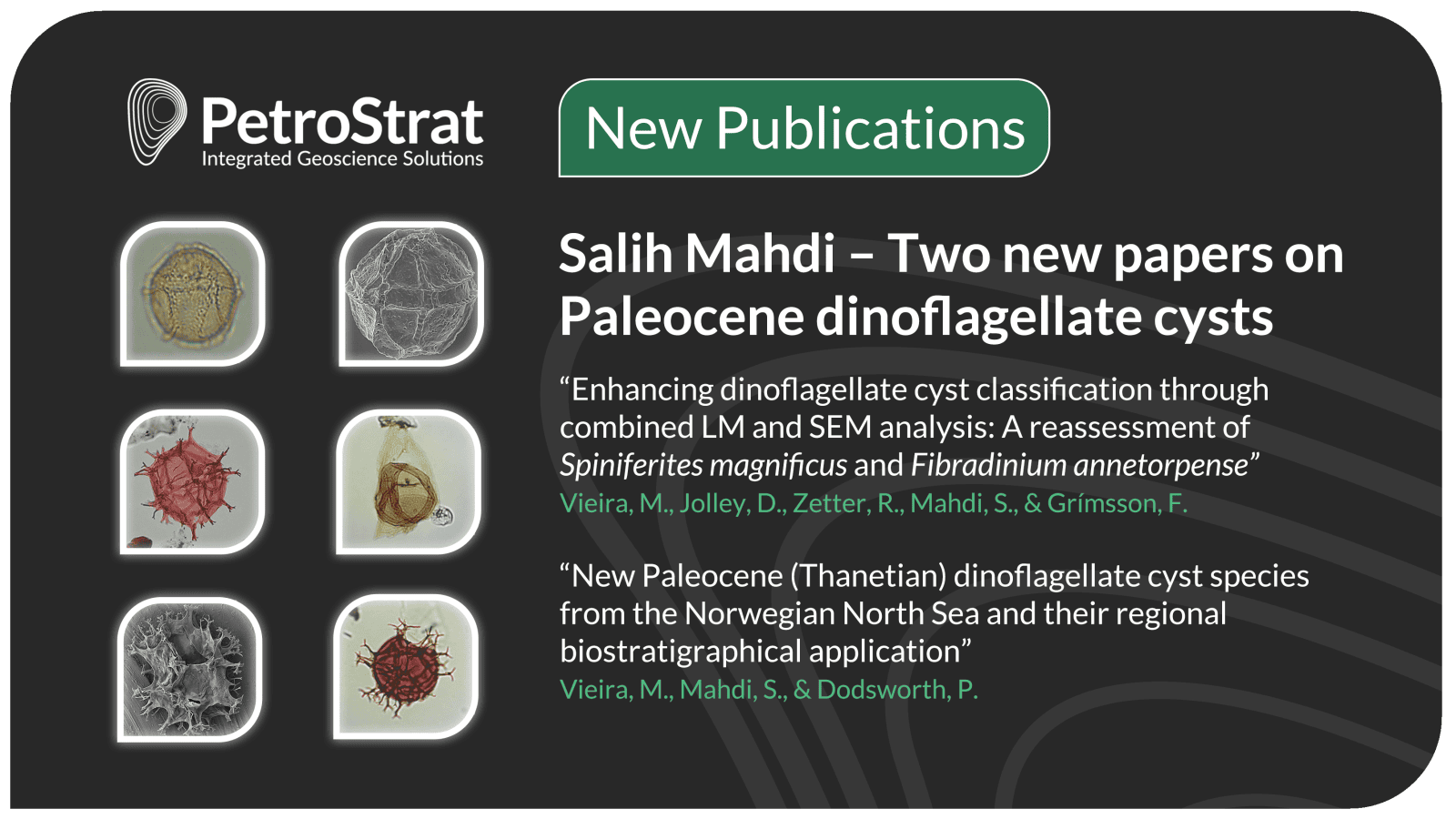
Salih Mahdi, one of our Principal Palynologists, recently published two papers sharing some of PetroStrat’s collaborative research with other organisations.
We are proud to spotlight and provide exclusive executive summaries of both papers.
Short biography of Salih Mahdi

Salih Mahdi is Principal Palynologist/Stratigrapher at PetroStrat. He earned a BSc in Geology from the University of Baghdad and completed a PhD in Carboniferous palynology of northern England at Aston University (1982).
He joined Gearhart Geoconsultants in 1986, focusing on Mesozoic and Paleogene chronostratigraphy in the North Sea. Later, he extended his work to carboniferous palynology in the southern North Sea (UK/Dutch sectors), the Irish Sea, and onshore UK.
Over decades, he has built deep biostratigraphic expertise across Paleogene, Mesozoic, and Palaeozoic sequences in northwest Europe and in regions including Brazil, the Falkland Islands, North & West Africa, the Middle East (Iraq, Qatar, Oman, and Syria), India, and Pakistan.
Paper 1 – Enhancing Dinoflagellate Cyst Classification Through Combined LM and SEM Analysis: A Reassessment of Spiniferites magnificus And Fibradinium annetorpense
An executive summary of this paper
In this study, we combine Light Microscopy (LM) and Scanning Electron Microscopy (SEM) to refine the taxonomy of two key Paleocene dinoflagellate cysts Spiniferites magnificus and Fibradinium annetorpense. Using the single-grain method, we show how SEM complements LM by revealing previously unresolved fine morphological structures.
SEM analysis of Spiniferites magnificus revealed novel diagnostic characteristics, such as variable intergonal processes, perforated sutural crests, and well-developed trifurcate gonal processes. These findings enhance its species definition and indicate that morphological variation may reflect environmental factors such as salinity.
For Fibradinium annetorpense, SEM imaging clarified cyst tabulation and reinterpreted the fibrous outer wall as continuous ridges and indentations outlining paraplate margins, with nanoscale rings encircling each plate.
Both species hold strong biostratigraphic importance: S. magnificus marks the Late Danian interval within the North Sea Basin, while F. annetorpense extends from the Late Cretaceous to the Thanetian, with this study focusing on upper Danian material from western Greenland.
Our results demonstrate the analytical power of SEM in dinoflagellate cyst research and suggest a wider application of this approach to improve taxonomic accuracy and resolve long-standing classification uncertainties.
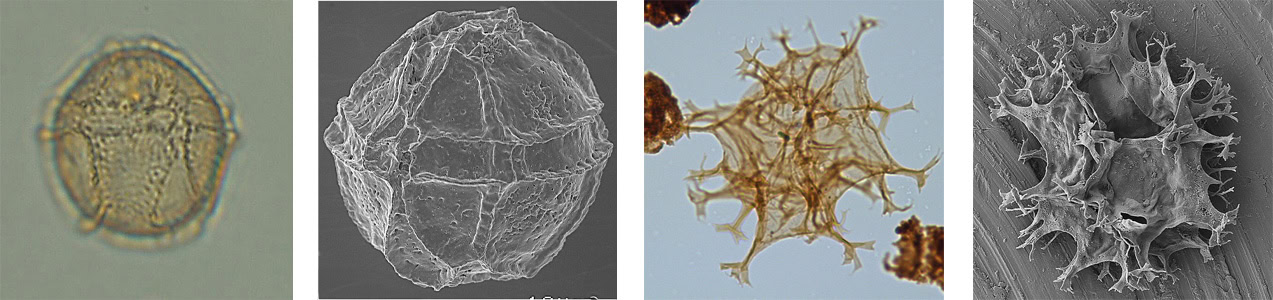
All images are reproduced under CC BY 4.0
- Light microscope photographs of Fibradinium annetorpense n. emend
- SEM photos of Fibradinium annetorpense n. emend.
- Spiniferites magnificus Vieira et al., 2018a n. emend
- SEM photos of Spiniferites magnificus specimen
Acknowledgements
Electron Microscopy was conducted at the ACEMAC (Aberdeen Centre for Electron Microscopy, Analysis and Characterisation) Facility, University of Aberdeen. We thank John Still for technical support with the SEM work and the reviewers for their constructive comments and valuable suggestions.
Citation
Vieira, M., Jolley, D., Zetter, R., Mahdi, S., & Grímsson, F. (2025). Enhancing dinoflagellate cyst classification through combined LM and SEM analysis: A reassessment of Spiniferites magnificus and Fibradinium annetorpense. Review of Palaeobotany and Palynology. https://doi.org/10.1016/j.revpalbo.2025.105300.
Paper 2 – New dinoflagellate species from the Paleocene (Thanatian) of the Norwegian North Sea
An executive summary of this paper
In this study, we present six novel dinoflagellate cyst taxa from the Thanetian (Late Paleocene) of the Norwegian North Sea. Five are elevated to species rank; Cerodinium inflatum, Operculodinium plenum, Spiniferites crassus, Spiniferites pseudorhomboideus and Spiniferites vermiculatus. Additionally, one is introduced as a subspecies, Spiniferites fentonii subsp. pumilus.
We recovered these taxa from expanded sections in the Lista and Heimdal formations, which reveal high sedimentation rates and mass-flow deposits. Each taxon exhibits narrow stratigraphical ranges, which enhances resolution in zonation schemes and enables finer correlation of Paleocene sequences.
We trace the history of several taxa first flagged informally by Ichron (now PetroStrat) in the 1990s and establish their formal taxonomy and diagnostic features. That formalisation strengthens their usefulness as regional biostratigraphic markers across both the Norwegian and UK sectors of the North Sea Basin.
We argue that integrating these new taxa refines the Thanetian biozonation and improves age control in subsurface correlation and reservoir evaluation. These findings underscore the continuing power of palynological detail in calibrating stratigraphic frameworks across Paleogene successions in Northwest Europe.
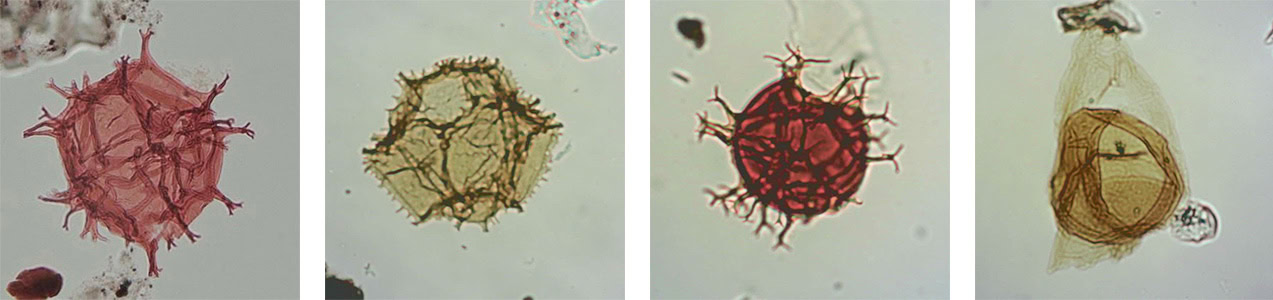
- Spiniferites fentonii subsp. pumilus subsp. Nov
- Spiniferites pseudorhomboideus sp. nov.
- Spiniferites crassus sp. nov.
- Cerodinium inflatum sp. nov.
Acknowledgements
We gratefully acknowledge AkerBP for their permission to publish this research paper. We thank all PetroStrat staff who worked alongside Salih, with special mention to Neil Jones and Steve Jones from our laboratories for their work in sample preparation. Special thanks to David Jolley and John Still (University of Aberdeen) for SEM work. Thanks to editor Jim Riding and the reviewer Alina I. Iakovleva for their support during the review and publication process.
Citation
Vieira, M., Mahdi, S., & Dodsworth, P. (2025). New Paleocene (Thanetian) dinoflagellate cyst species from the Norwegian North Sea and their regional biostratigraphical application. Palynology. https://doi.org/10.1080/01916122.2025.2534831